American cockroaches (*Periplaneta americana*) thrive inside municipal drainage infrastructure, sewer line cleanouts, and moist subterranean voids across Bexar County. When seasonal summer temperatures regularly exceed…
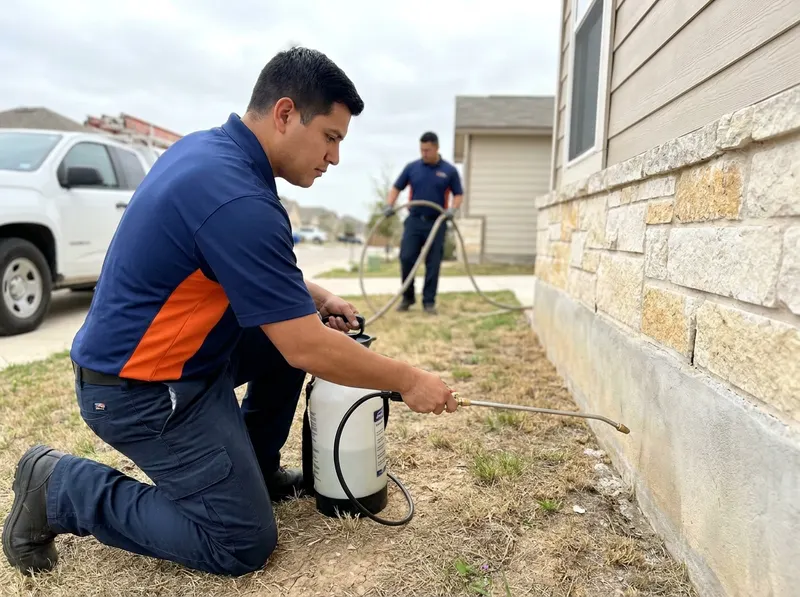
American cockroaches (*Periplaneta americana*) thrive inside municipal drainage infrastructure, sewer line cleanouts, and moist subterranean voids across Bexar County. When seasonal summer temperatures regularly exceed 95 degrees Fahrenheit or severe storm deluges flood underground systems near Helotes Creek and the San Antonio River Walk basin, mature adults travel vertically toward slab foundations. The standard consumer mistake involves applying aerosol contact sprays along interior baseboards; this reactive measure fails because it targets wandering foraging insects rather than the structural migration path. FalconRoot Extermination establishes an exterior perimeter defense engineered around San Antonio's native limestone outcroppings and dense caliche clay soils, which routinely pull away from poured concrete during dry months and create unmonitored subterranean subterranean highways directly to foundation stem walls.
Decision-fit for this service focuses entirely on exterior exclusion rather than invasive interior chemical broadcasts. If roach sightings are restricted to German cockroaches (*Blattella germanica*) congregating strictly inside kitchen cabinetry or motor housings of appliances, a foundation barrier treatment is the incorrect option; German roaches demand interior bait matrixing and insect growth regulators. Conversely, when large, flying adults measuring 1.5 to 2 inches emerge from bathroom plumbing voids, exterior weeping brick joints, or crawlspace accesses, foundation barrier treatments deliver optimal control. The operational trade-off involves prioritizing rigorous exterior containment: mechanical exclusion and residual ground bands eliminate the insect before structural entry occurs, removing the need to disperse airborne pyrethroids across interior bedrooms where children or household pets rest.
Treatment execution follows a methodical protocol adhering to standards from the Environmental Protection Agency and structural pest guidance from the Texas A&M AgriLife Extension Service. First, technicians clear settled mulch, fallen leaf litter, and river stone away from foundation edges to expose bare concrete footings. Second, a continuous 3-foot vertical band is applied to the foundation wall combined with a 10-foot horizontal perimeter band using non-staining suspension concentrates certified under the Texas Department of Agriculture structural pest regulations. Third, water-resistant pyrethroid or neonicotinoid granules are distributed into adjacent turfgrass and garden beds, followed by targeted dusting of brick weep holes using breathable silica or borate formulations compliant with PCT Magazine technical pest benchmarks.
Property topography dictates specific barrier dynamics across distinct San Antonio neighborhoods. Historic crawlspace foundations framed over pier-and-beam architecture in the King William Historic District and Monte Vista require sub-floor access evaluations and skirting treatments, whereas post-tension slab homes built into fractured limestone in Stone Oak and Dominion demand chemical line injections along exterior masonry expansion joints. Commercial runoff patterns near the Medical Center and older sewer cleanouts throughout Alamo Heights, Southtown, and Oakland Estates are secured with specialized gasket checks and perimeter hydro-resistant baits evaluated according to Centers for Disease Control and Prevention environmental health guidelines. Every material application complies with active ingredient safety thresholds defined by the Occupational Safety and Health Administration, the structural parameters of the National Pest Management Association, biological transport principles documented by the Entomological Society of America, and watershed management recommendations managed by the San Antonio River Authority along with water protection rules from the Texas Commission on Environmental Quality.
Every job gets a firm, written price after a free on-site visit.
For standards, safe disposal, and service guidance on pest control services in San Antonio, TX, useful references include U.S. EPA, ENERGY STAR, U.S. Dept. of Energy, Consumer.gov, U.S. Census Bureau, and Google Maps. General consumer and small-business resources are available from USA.gov, Better Business Bureau, FTC Consumer Advice, U.S. Small Business Administration, and Ready.gov.
Tell us about your american roach foundation barrier treatments job in San Antonio and we'll send a clear, written quote, usually the same day.
 FalconRoot Extermination