Red imported fire ant infestations throughout Bexar County thrive inside the fissured Edwards Limestone layer and shallow caliche clay soils characteristic of North San Antonio communities like Stone Oak and the…
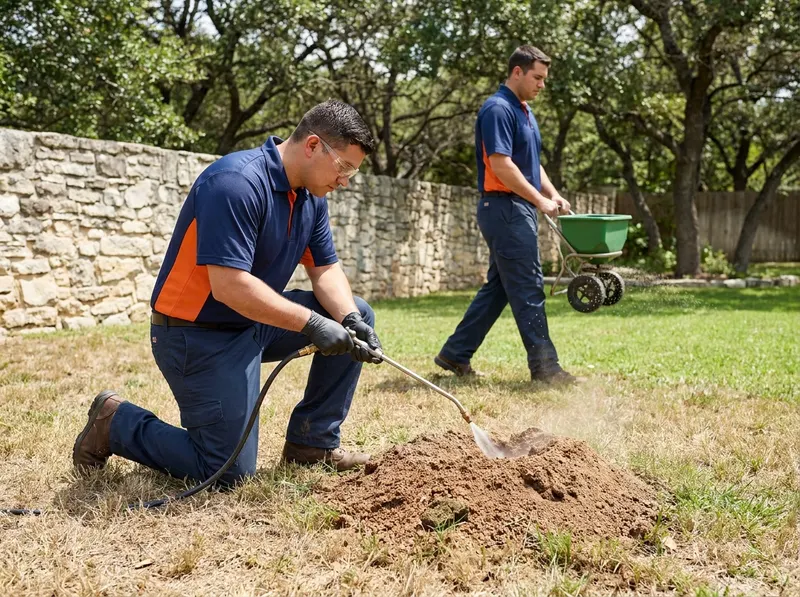
Red imported fire ant infestations throughout Bexar County thrive inside the fissured Edwards Limestone layer and shallow caliche clay soils characteristic of North San Antonio communities like Stone Oak and the Dominion. Standard consumer store sprays only kill outer worker ants, which triggers nest splitting where satellite queens establish multiple defensive mounds overnight. FalconRoot Extermination executes an Integrated Pest Management protocol based on guidelines from the Texas A&M Department of Entomology. The method utilizes dual-vector eradication: pressurized liquid inundation using specialized injectors to push termiticides and insect growth regulators 18 to 36 inches downward into nursery tunnels, paired with wide-area sterile granular bait distribution calibrated to the foraging radius defined by the USDA Agricultural Research Service. This protocol preserves local environmental safety, complying with soil runoff parameters established by the Texas Commission on Environmental Quality while protecting domestic animals under guidelines from the ASPCA Animal Poison Control Center.
Fire Ant Mound Inundation and Broadcast Baiting Cost Factors in Bexar County
Treatment pricing reflects acreage, nest density, and bedrock depth. Standard quarter-acre suburban lots across Alamo Heights, Monte Vista, and Oakland Estates average $250 to $325. Half-acre to one-acre properties bordering creek corridors such as Helotes Creek or the San Antonio River Walk basin in Southtown and the King William Historic District require secondary granular broadcast lines and range from $375 to $495. For multi-acre ranchettes requiring broadcast spreaders mounted to utility vehicles, rates begin at $650. Every project adheres strictly to our non-negotiable $250 service minimum. In accordance with the EPA Office of Pesticide Programs, all formulations utilize low-toxicity active ingredients like hydramethylnon or methoprene that bind securely to soil organic matter, minimizing water solubility. Structural technicians also coordinate with safety standards set by the Occupational Safety and Health Administration to protect property infrastructure, irrigation systems, and outdoor HVAC wiring hubs from acidic ant damage.
Decision Guidance and Tactical Site Fit
Direct mound inundation fits active nesting sites where aggressive colonies threaten high-traffic zones, children's playsets, or canine runs near the Medical Center. Broadcast baiting fits property-wide maintenance across open turf, forcing worker ants to carry biological regulators directly to the subterranean brood. In contrast, properties experiencing passive native ant species do not require mound injections; preserving non-aggressive native species maintains natural ecological competition according to the Texas Parks and Wildlife Department. When colonies breach electrical control boxes or irrigation pedestals, technicians execute dry chemical injections compliant with standards from the International Society of Arboriculture and electrical safety codes from the National Fire Protection Association. FalconRoot Extermination operates with targeted perimeter defense and zero recurring contracts, ensuring home and business owners pay strictly for verified remediation.
Every job gets a firm, written price after a free on-site visit.
For standards, safe disposal, and service guidance on pest control services in San Antonio, TX, useful references include U.S. EPA, ENERGY STAR, U.S. Dept. of Energy, Consumer.gov, U.S. Census Bureau, and Google Maps. General consumer and small-business resources are available from USA.gov, Better Business Bureau, FTC Consumer Advice, U.S. Small Business Administration, and Ready.gov.
Tell us about your fire ant mound inundation and broadcast baiting job in San Antonio and we'll send a clear, written quote, usually the same day.
 FalconRoot Extermination